Third-wave feminism is a flexible label for activism and thought that became prominent in the 1990s and early 2000s. It responded to the gains and exclusions of earlier movements while growing inside a media-rich, post–Cold War, increasingly networked culture. Third-wave politics emphasized intersectional identities, sexual agency, popular culture, self-definition, and contradiction. It resisted the idea that one experience or respectable style could represent all women, yet it also faced a difficult question: how can plural identities support collective political power? The answer depends on coalition, material institutions, shared rights, and accountable organization across enduring, significant social differences.
A: The label is commonly associated with the 1990s and early 2000s, though its ideas have earlier lineages and varied timelines.
A: It emphasized plural identities, culture, queer theory, sexual agency, self-definition, and critique of one universal model of women.
A: No. It included collective organizing and coalition, though critics argued that personal choice and cultural politics sometimes overshadowed institutions.
A: It challenged single-axis accounts and required gender to be studied with race, class, sexuality, disability, nationality, and other structures.
A: They let people outside mainstream publishing combine art, experience, argument, networks, and practical organizing information.
A: It emphasized sexual agency, pleasure, diversity, and opposition to shame while debating coercion, commerce, and unequal power.
A: It questioned fixed categories, compulsory heterosexuality, binary gender, and the institutions that enforce normality.
A: Critics cite consumerism, unstable organization, cultural emphasis, specialized language, and difficulty converting plurality into common strategy.
A: Some rhetoric did, but third-wave thought also extended critiques developed by earlier Black, lesbian, socialist, postcolonial, and other feminists.
A: Respect plural agency while still analyzing institutions, markets, histories, and the collective structures needed for freedom.
The Third Wave Entered a Changed Political Culture
Earlier feminist victories had altered education, work, law, and public expectations, but inequality and violence remained. Younger activists encountered feminism partly through institutions and mass media rather than only through movement organizations.
Their politics developed amid globalization, conservative backlash, new media, changing sexual cultures, and critiques from women marginalized in dominant feminism.
Intersectionality Challenged a Single Axis
Black feminist thought had long connected race, class, gender, and sexuality. Intersectionality gave influential language to the way institutions combine these structures. Third-wave discourse helped move this challenge toward the center of feminist identity.
Identity Became Plural and Contested
Woman could not serve as a simple political category when race, disability, sexuality, nationality, religion, and class changed its meaning. Third-wave politics valued self-definition while asking how categories structure legal recognition and collective action.
Plurality challenged exclusion, but it also required methods for choosing shared priorities rather than assuming automatic unity.
Culture Was Treated as a Political Institution
Music, television, advertising, fashion, film, magazines, and emerging online spaces shaped gendered possibility. Representation affected belonging and stereotype, while cultural industries organized labor, profit, and access.
Zines Made Political Media Personal
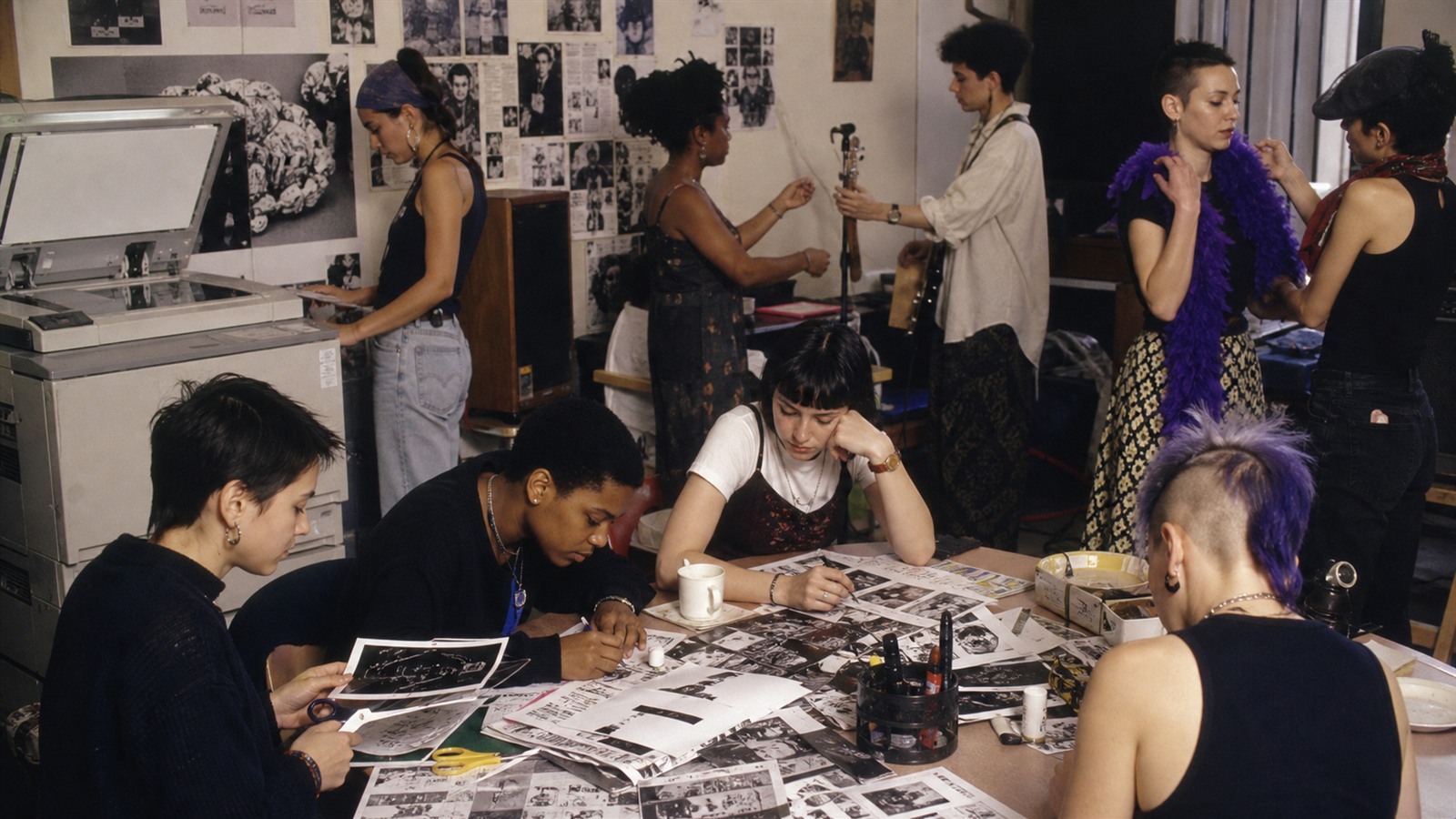
Photocopied publications combined diary, criticism, interviews, art, music, health information, and organizing. Their small scale allowed voices ignored by major publishers to circulate through networks.
Personal form did not necessarily mean private politics. It connected lived contradiction to community and public argument.
Sexual Agency Complicated Victim Narratives
Third-wave and sex-positive feminists emphasized pleasure, experimentation, queer sexuality, and women’s authority to interpret their choices. They resisted politics that treated protection as control.
Choice Required Structural Context
A chosen practice can express agency and still occur within commercial pressure, beauty hierarchy, economic need, or unequal risk. Feminist evaluation cannot simply approve every choice or dismiss the chooser as deceived.
Holding both truths—agency and constraint—became a characteristic third-wave method.
Queer Theory Disrupted Stable Categories
Queer approaches examined how institutions produce normal and deviant identities through language, law, medicine, family, and culture. Gender and sexuality appeared less fixed and more governed.
Popular Feminism Expanded Reach
Celebrities, magazines, films, and products brought feminist language to wide audiences. Visibility could normalize ambition and autonomy, yet commercial feminism often reduced liberation to confidence or consumption.
The political question became whether representation redistributed decision power or merely opened a market.
Do-It-Yourself Politics Lowered Entry Barriers
People could publish, perform, meet, and organize without waiting for established leaders. Informal projects supported experimentation and local response. They could also depend on unpaid labor and disappear without governance or resources.
Generational Language Created Distance
Calling a politics third wave distinguished it from stereotypes about earlier feminism. The contrast sometimes enabled innovation and sometimes misrepresented second-wave diversity.
Intellectual history shows continuity: many supposedly new concerns were developed by women of color, queer feminists, workers, and anticolonial thinkers in earlier decades.
Agency Replaced One Respectable Feminine Ideal
Third-wave feminism resisted prescriptions about how a liberated woman should dress, speak, work, desire, or form relationships. This pluralism protected self-interpretation.
Respectability Remained Unequally Distributed
Race, class, sexuality, disability, and immigration affected who could reject convention without losing safety or employment. Transgression celebrated in one person could be punished in another.
Intersectional cultural analysis asks who receives room for complexity and who remains confined by stereotype.
Coalition Became a Negotiated Practice
If identities and interests differ, solidarity must be constructed through listening, conflict, material commitment, and shared goals. Coalition does not erase identity; it prevents difference from becoming isolation.
Institutional Politics Never Disappeared
Third-wave activists worked on violence, reproductive justice, queer rights, labor, racism, health, education, and global justice. Cultural visibility coexisted with legal and organizational campaigns, though public memory often emphasizes style.
The theory is clearer when culture and institutions are analyzed together rather than ranked as real and superficial politics.
The Market Learned Feminist Language
Advertising could sell empowerment while supply chains relied on low-paid women workers. Identity became a branding resource. Third-wave critique revealed how quickly liberation language can be detached from redistribution.
Read a Cultural Choice Politically Without Erasing Agency
Consider a young woman using fashion, music, or sexual imagery that an earlier feminist might interpret as objectifying. A third-wave analysis begins by asking what the participant says the practice means and what pleasure, identity, community, or refusal it enables.
It then studies the surrounding industry. Who owns the platform, defines visibility, profits from the image, controls working conditions, and sets narrow standards of beauty or marketability?
Social position changes the stakes. The same style can be read differently across race, class, sexuality, disability, religion, and workplace context. Choice occurs within histories that make some bodies hypervisible and others invisible.
Neither agency nor structure should disappear. Calling every participation false consciousness denies people’s interpretive power; treating every chosen act as liberating ignores markets, coercion, and unequal consequences.
Political judgment therefore asks whether options are broad, consent is meaningful, labor is fair, representation is plural, and people can criticize the practice without punishment. Contradiction can be acknowledged rather than resolved by slogan.
This method captures a third-wave strength. Culture is neither a trivial distraction from politics nor a realm where individual expression automatically defeats power. It is a contested institution through which identities and economic relationships are made. Political economy is the final safeguard against reducing the third wave to culture. During the period, deregulation, privatization, precarious work, welfare restructuring, mass incarceration, and global supply chains changed the material conditions of identity. Feminist responses examined how a rhetoric of flexible individual choice could accompany weaker public support and greater household risk. A worker might gain expressive freedom while losing stable hours, health coverage, or affordable housing. Cultural recognition and social citizenship had to advance together. Reproductive justice, labor feminism, antiracist organizing, and queer economic analysis supplied bridges. They connected identity to clinics, prisons, schools, workplaces, borders, benefits, and neighborhoods. This institutional focus also clarifies empowerment. Feeling capable and seeing people like oneself can support action, but power includes resources, organization, legal standing, ownership, and the ability to impose costs on decision-makers. A campaign should ask what capacity remains after a product, performance, or media cycle ends. When participants gain skills, networks, archives, services, and governing authority, cultural politics builds durable power. The third wave’s best legacy is not a celebration of endless difference. It is a disciplined refusal to purchase unity by silencing complexity, paired with the recognition that people living differently can still construct common rights and material institutions. The generation metaphor should be used carefully. Activists of different ages worked simultaneously, and many ideas associated with the third wave were developed earlier by Black, queer, Indigenous, working-class, postcolonial, and other feminists. Presenting young feminists as discovering difference can erase those intellectual lineages. The label is most useful when it identifies a changed context and style of debate rather than a clean replacement of second-wave thought. It marks the growing visibility of intersectionality, queer theory, independent media, popular-culture criticism, and deliberately plural forms of feminist identification. Third-wave organization often favored decentralized projects, temporary coalitions, cultural production, local activism, and do-it-yourself media. These forms lowered entry barriers and supported experimentation. They could also produce fragile institutions, uneven accountability, and difficulty sustaining campaigns after attention moved. Formal organizations possess their own exclusions, but budgets, staff, records, and governance can preserve capacity. The lesson is not that networks or institutions are superior. Durable feminist politics needs movement across both: flexible spaces for new voices and accountable structures able to enforce rights, redistribute resources, and survive beyond a cultural moment. The period’s attention to language reflected real political stakes. Naming multiracial, bisexual, transgender, disabled, immigrant, or other experiences challenged administrative and movement categories built around a presumed subject. Yet vocabulary can become a status test when specialized terms move faster than shared understanding. Third-wave pluralism works best when language expands recognition and remains open to explanation, translation, and revision. Political education should invite people into more accurate concepts rather than use fluency as proof of moral worth. This democratic approach connects identity to coalition: people can describe difference precisely while building common projects through accessible discussion and material commitments. Reproductive justice illustrates how third-wave plurality can produce a common political program. A narrow account of choice may focus on whether government permits abortion. Reproductive-justice organizing, developed by women of color, links that right to the ability to have children, not have children, and raise families in safe and sustainable communities. Health care, sterilization abuse, environmental harm, policing, incarceration, disability, immigration, wages, housing, and childcare all shape those capabilities. Identity is not an alternative to material politics here; social position reveals which institutions make reproductive freedom unequal. The framework also corrects a consumer model in which individual purchasing or clinic access stands for liberation. Collective infrastructure determines whether a legal option is usable. Globalization created another test. Brands marketed cosmopolitan female empowerment while relying on garment, agricultural, electronics, and care workers across borders. A professional woman could gain career freedom through products and services made by lower-paid women with less mobility. Third-wave transnational feminism traced these relationships without assuming that workers lacked agency or shared one political priority. Labor rights, trade rules, migrant status, union freedom, and corporate accountability joined cultural representation. The analysis showed why an image of a confident woman tells little about the conditions under which the image and product were made. Disability perspectives widened the critique of identity and agency. Celebrating independence, sexual attractiveness, productivity, or transgression can reproduce ableist ideals. Disabled feminists emphasized access, interdependence, bodily variation, supported decision-making, and the politics of medical authority. Their work demonstrates that pluralism requires redesigning the environment, not merely welcoming additional identities into a fixed space. Finally, third-wave politics affected men and masculinity by questioning binary roles, heterosexual norms, and emotional restriction. A politics of self-definition can enlarge men’s lives, but feminist analysis still asks who holds structural power and who performs care. Freedom from rigid identity succeeds when it changes relationships, resources, and institutions rather than offering personal reinvention as a substitute for shared responsibility. These examples show how the third wave’s cultural sensitivity can remain materially ambitious. Identity identifies mechanisms, coalition organizes across them, and durable policy changes the conditions under which expression becomes safe and meaningful.
Plurality Needs Durable Power
Recognition gives people room to name their lives, but rights, services, worker organization, and accountable institutions protect that room over time.
The third wave’s enduring challenge is productive: build a feminism flexible enough for complex identities and organized enough to change the structures that make some identities costly to inhabit.