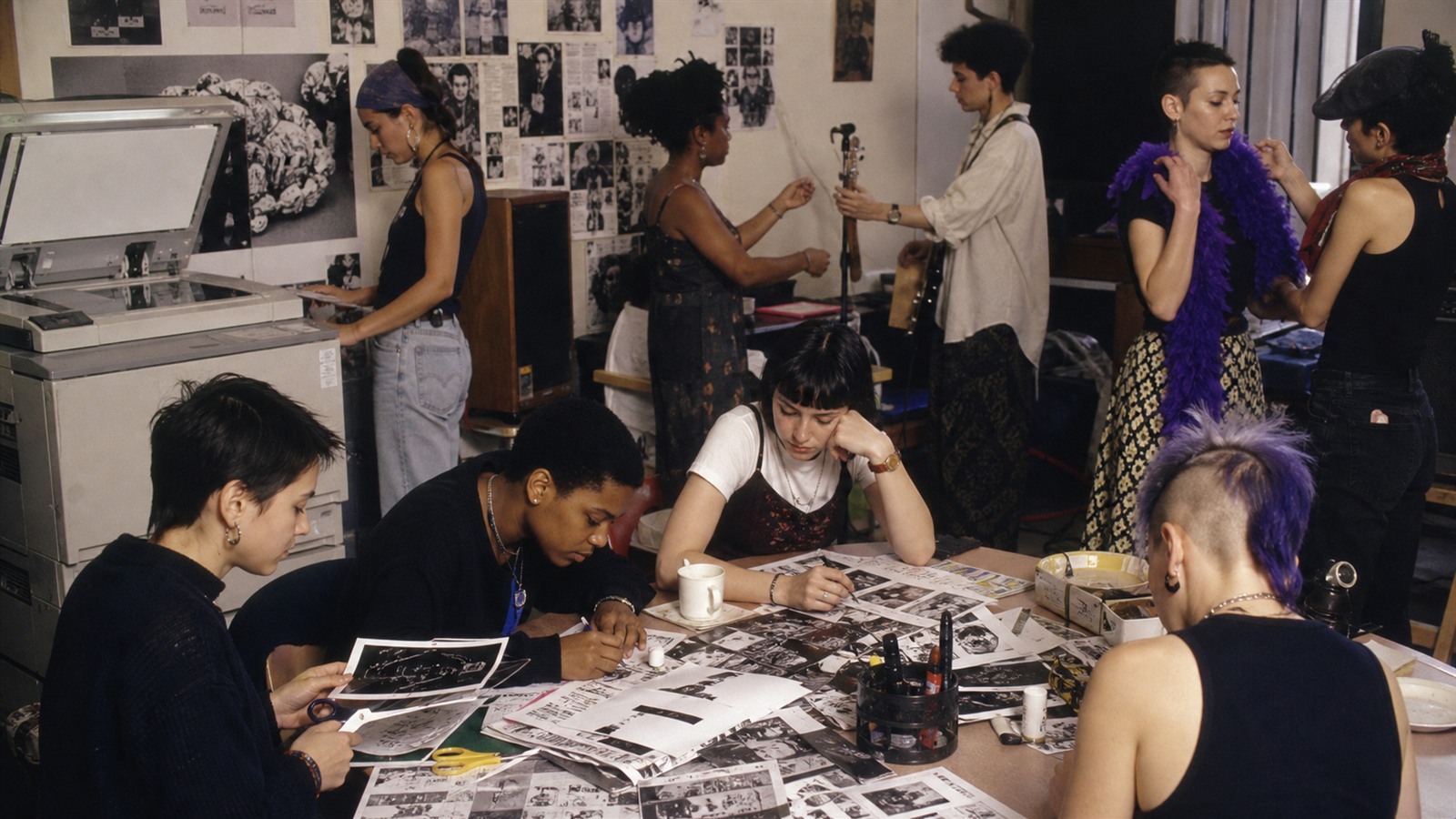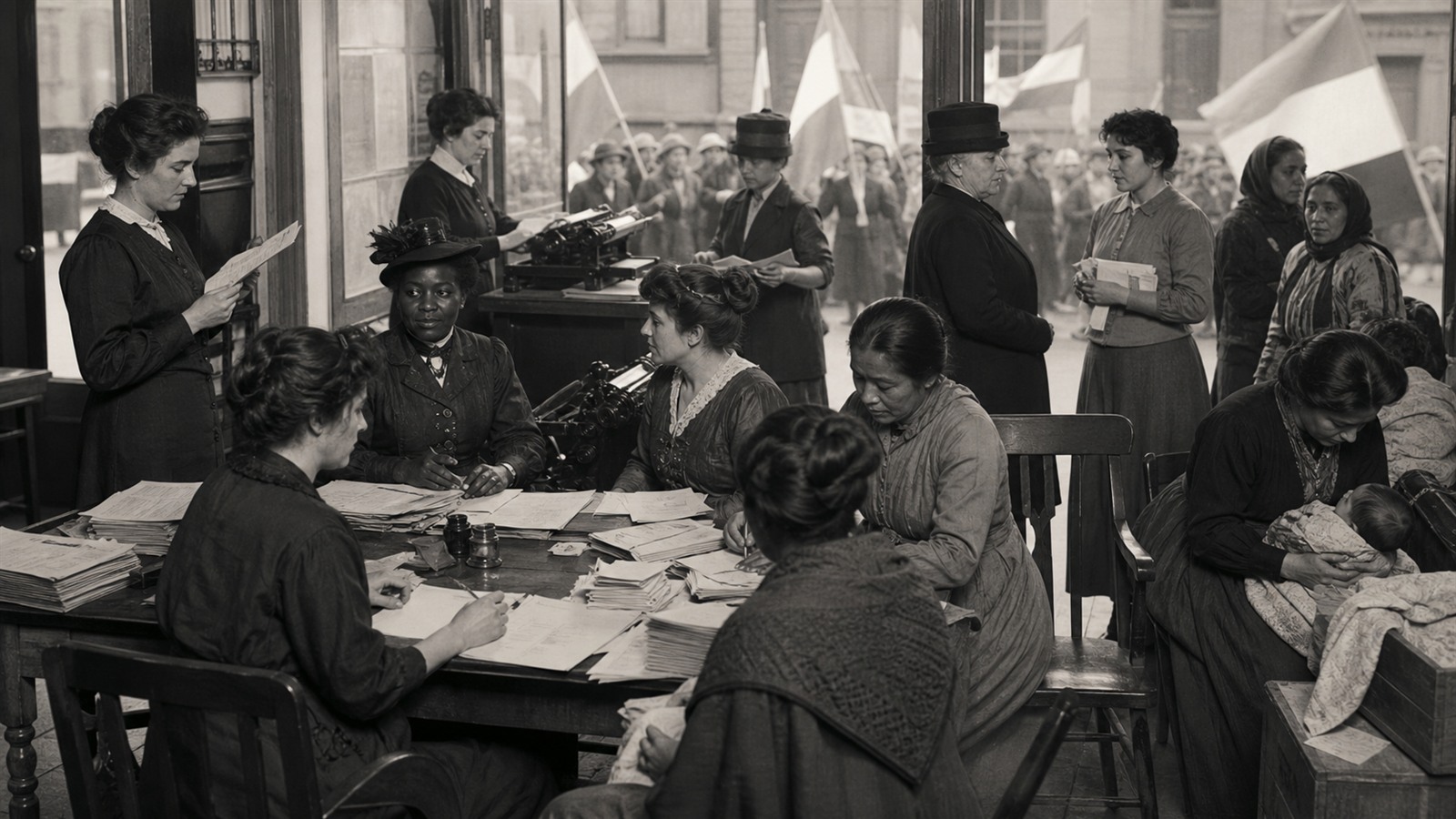
The first wave is a later label for feminist activism and thought concentrated mainly in the nineteenth and early twentieth centuries. It is commonly associated with women’s suffrage, but the politics was broader: legal identity in marriage, property, education, employment, custody, temperance, abolition, labor, and public speech. The wave metaphor is useful for orientation yet can flatten different countries and movements. A careful account treats first-wave feminism as a contested field of organizing, achievement, exclusion, and political invention. Industrialization, empire, migration, abolition, religious reform, and revolutionary change gave campaigns different starting points. An educated property owner confronting coverture, a garment worker organizing hours, a formerly enslaved woman demanding bodily and political security, and an Indigenous woman defending sovereignty did not enter the movement through the same problem. Their claims sometimes converged and sometimes exposed contradictions in the category of universal womanhood. The period’s theory emerged through these encounters as much as through published declarations. Reading it well means holding two judgments together: first-wave activists transformed legal citizenship and public authority, and prominent organizations sometimes bargained with racial, class, or colonial hierarchy. Neither judgment cancels the other. Together they explain why formal rights and internal movement accountability became inseparable parts of later feminist politics. The first wave left a durable democratic toolkit: association, petition, publishing, litigation, direct action, coalition, and the insistence that dependency created by law is open to deliberate democratic and lasting political change.
A: The label usually covers much of the nineteenth and early twentieth centuries, with dates varying by country and political issue.
A: No. It addressed property, marriage, education, custody, work, public speech, slavery, temperance, and legal personhood.
A: It rejected household representation and recognized women as individual participants in choosing public authority.
A: In common-law systems, it was the doctrine under which a married woman's legal identity and property rights were heavily absorbed by her husband.
A: Abolition supplied organizing networks and universal freedom arguments while exposing racism within women's-rights coalitions.
A: Yes. They organized through antislavery, suffrage, clubs, churches, journalism, labor, and community work while confronting racism and sexism.
A: It is political reasoning that grounded women's public claims in motherhood or caring roles, expanding authority while sometimes reinforcing gender expectations.
A: It can impose a Western timeline, hide continuous activism, and center well-known suffrage organizations over other struggles.
A: No. Racial, colonial, economic, administrative, and social barriers continued to limit political power and participation.
A: Formal citizenship is essential, but a universal right remains incomplete when institutions and movements exclude people from using or shaping it.
The Wave Was Named After the Movement
Participants did not all describe themselves as members of a first wave. Later periodization grouped several generations of activism to distinguish them from renewed movements in the twentieth century.
The label helps organize history, but local dates and priorities differ. It should begin inquiry, not substitute for it.
Suffrage Became the Most Visible Demand
Voting directly challenged political dependence. Women obeyed laws, paid taxes, worked, raised citizens, and experienced state power while lacking an individual voice in selecting lawmakers. Suffrage made the contradiction easy to state.
Citizenship Extended Beyond the Ballot
Political membership also involved property, contract, jury service, office, education, mobility, and family authority. First-wave thinkers disputed a legal order that treated women as citizens for duties but dependents for power.
Their programs varied, yet they widened the meaning of equal civil personhood.
Marriage Law Was a Central Political Target
Rules governing married women’s property and earnings gave husbands economic authority. Reform enabled greater independence and exposed the household as a legal institution rather than a realm untouched by government.
Education Challenged Claims of Incapacity
Excluding women from advanced study helped produce the limited experience then cited as proof of their nature. Educational campaigns attacked this circular reasoning and opened paths into teaching, medicine, law, scholarship, and organization.
Access remained divided by race, class, disability, and location, shaping who represented educated womanhood.
Abolition and Women’s Rights Intersected
Antislavery activism gave many women experience in petitioning, fundraising, publication, boycotts, and speaking. It also generated analysis of freedom, bodily control, family separation, and coerced labor.
Black Women Challenged a False Universal
Black women confronted racism within women’s movements and sexism within antiracist movements. Their speeches, journalism, clubs, mutual aid, and community leadership showed that a category centered on white women could not represent all women.
The critique anticipated later intersectional analysis even though its modern vocabulary did not yet exist.
Labor Created Another Feminist Politics
Women factory and garment workers organized over wages, hours, safety, dignity, and union recognition. Their struggle linked gender to class and questioned a rights agenda focused on property-owning individuals.
Temperance Joined Morality to Household Power
Temperance movements offered women an accepted route into public activism and addressed real harms connected to alcohol, wages, and violence.
They could also become moralizing or coercive. Their history shows how reform, care, religion, and state authority combined.
Maternalism Opened and Restricted Public Roles
Some activists argued that women’s experience as mothers qualified them to reform health, education, labor, and welfare. The claim legitimized public action while risking the idea that women’s citizenship rested on one social role. Equal-rights and maternalist arguments often coexisted inside the same campaigns.
Organizations Built Political Capacity
Associations created leadership where parties and government excluded women.
Members mastered procedure, finance, communication, service provision, lobbying, and coalition. Organization itself changed who could appear as a political actor.
Militancy Exposed the Force Behind Exclusion
When petitions and lobbying failed, some movements used disruption and civil disobedience. Arrest, force-feeding, censorship, and public hostility revealed that political dependence was maintained through coercion, not custom alone. Strategic disputes over militancy reflected different risks and access among activists.
Empire Distorted Claims of Liberation
Some advocates presented Western women’s status as proof of civilizational superiority, overlooking empire’s violence and the inequality of their own societies.
Colonized women developed political agendas that joined national self-determination with challenges to gender authority.
Winning Suffrage Did Not Mean Universal Voting
Sex exclusions could be removed while racial terror, colonial status, citizenship law, property, literacy tests, and administration blocked others. Formal victory must be read alongside the actual electorate. This does not diminish suffrage. It clarifies the further institutions required for political equality.
The Wave Achieved Structural Legal Change
Across different jurisdictions, campaigns expanded voting, property, education, professions, custody, and public standing.
They changed the imaginable citizen and built movements future generations inherited.
Its Contradictions Became Part of Feminist Theory
Racism, class hierarchy, imperialism, restrictive respectability, and a narrow family model limited many organizations. Critiques from marginalized women forced the movement to confront representation within its own ranks. The first wave therefore offers both democratic achievements and a warning: an equality movement can reproduce hierarchy when its most privileged members define the universal subject.
Read Suffrage as a Theory of Citizenship
The vote was not simply a symbol. It gave women a recognized role in choosing lawmakers, made parties seek their support, and challenged the assumption that household men represented everyone politically.
Suffragists developed several justifications. Equal-rights arguments rested on personhood and consent. Contribution arguments pointed to women’s work, taxation, education, or civic service. Maternalist arguments claimed women would bring caring experience into public life.
These approaches opened different futures. Equal personhood questioned gender hierarchy directly, while maternalism could expand public authority yet preserve fixed roles. Movements often used more than one argument strategically.
The category women also concealed unequal access. Racial violence, citizenship restrictions, colonial rule, property requirements, and local administration could block voting even after sex exclusions changed.
Some white suffragists used racist appeals when alliances fractured, while Black women organized against both racism and sexism and built political work through clubs, churches, journalism, and community institutions.
Suffrage should therefore be understood as a major democratic transformation and an incomplete one. Its history teaches that winning a universal-sounding right requires attention to every institution that decides who can exercise it. Legal victories also changed daily bargaining inside households. Independent earnings and property did not guarantee equality, but they altered the consequences of disagreement and exit. Education and professional access widened possible lives, while custody reform challenged automatic paternal rule. These changes show why formal law and social power should not be treated as rivals. A statute can redistribute authority even before norms fully change, and organization can make the statute enforceable. Conversely, legal language may remain dormant when courts, employers, families, or administrators resist it. First-wave history is a study of this interaction between declared status and institutional practice. The wave metaphor creates two further risks. First, it can suggest that feminist politics disappeared between peaks, ignoring continuous local organizing and intellectual work. Second, periodization based on the United States or Britain may not fit movements under different legal, colonial, religious, or economic conditions. Historians can use the label while specifying place and issue. Doing so preserves a recognizable teaching tool without making one national timeline universal. It also brings forward campaigns that did not center suffrage but transformed land, labor, education, slavery, family, or national liberation. Organizations themselves were political laboratories. Members learned to chair meetings, raise funds, write bylaws, publish newspapers, collect data, speak publicly, and negotiate coalitions before formal institutions welcomed them. Clubs and mutual-aid groups provided services while building authority, especially in communities excluded from dominant suffrage associations. Yet voluntary work could reproduce class divisions when affluent women claimed to speak for workers or treated poor families as objects of reform. First-wave thought developed through these practical conflicts over representation: who may speak, who sets priorities, and how collective power remains accountable to those named in its cause. First-wave arguments about work were more diverse than the popular suffrage narrative suggests. Wage-earning women organized in factories, domestic service, agriculture, teaching, clerical work, and home-based trades. Protective labor law prompted a difficult debate. Limits on hours or dangerous work could reduce exploitation, but sex-specific rules could also justify excluding women from better-paid occupations and preserve men as the default workers. Equal treatment and special protection were therefore entangled long before later feminist disputes. Collective bargaining offered another route by giving workers power to set common standards rather than relying on paternal guardianship. Welfare reform created similar tensions. Maternal pensions and public-health programs recognized care as a social concern, yet administrators often judged morality, household form, race, immigration, and deservingness. Benefits could support independence or discipline poor women. The history shows that public provision needs clear rights and recipient voice, not simply benevolent intent. First-wave activists also changed public space. Marches, lectures, pickets, newspapers, and conventions asserted that women could appear as political authorities before voters or officials granted recognition. Clothing, respectability, and demeanor became strategic questions because hostile audiences judged the speaker’s right to speak. Some movements used conventional femininity to reassure observers; others deliberately disrupted it. These choices were shaped by unequal exposure to violence and stereotype, making no single tactic available to everyone on equal terms. After enfranchisement, the movement faced a problem common to successful reform coalitions: a shared demand no longer organized every participant. Some groups entered parties, government, social reform, peace activism, labor, or international organizations. Others pursued an equal-rights amendment or additional family and workplace reform. Differences over protective law, race, colonialism, class, and the role of the state became more visible. The period between first and second waves was not politically empty; women continued to organize even when later histories gave less attention to their work. Internationally, suffrage arrived through varied routes—legislative change, constitutional rupture, decolonization, or state-led reform—and sometimes under authoritarian governments. Voting rights could coexist with limited democracy for everyone. This variation reinforces a key theoretical lesson: enfranchisement is a necessary power, but its meaning depends on parties, civil liberty, electoral administration, social equality, and whether citizens can organize between elections. The first wave enlarged formal membership; its history points directly toward the later feminist study of substantive citizenship.
The Legacy Is Formal Equality Plus Unfinished Access
First-wave political thought established that women are individual citizens, not dependents represented by men. It also revealed that legal status never operates alone.
Its enduring lesson is double: fight uncompromisingly against explicit exclusion, and examine race, class, empire, labor, family, and administration so the right won in principle becomes power shared in practice.