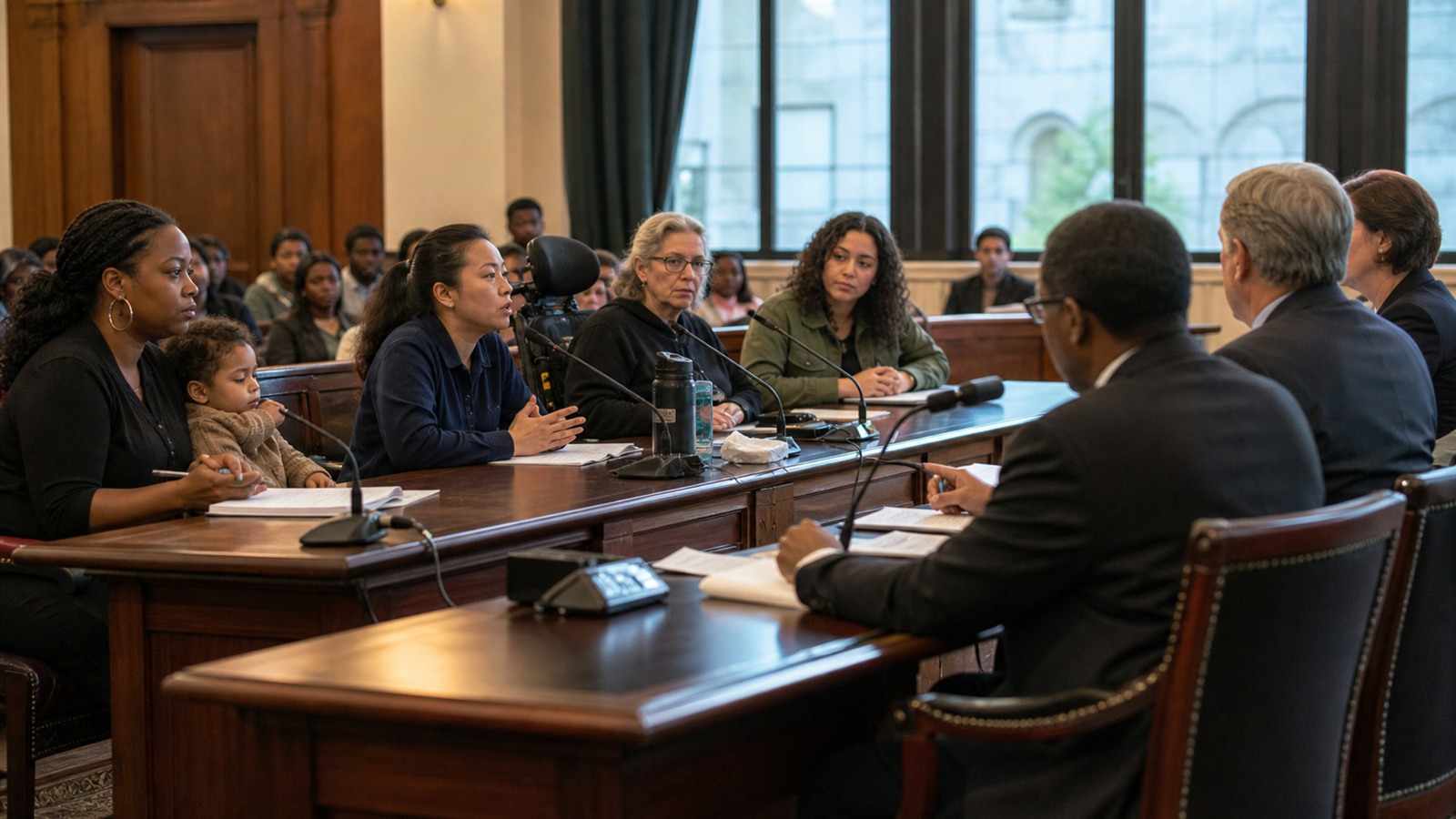
Political authority is often pictured as a legislature, court, police force, or executive office. Feminist political theory studies those institutions, then asks what the picture leaves outside the frame. Power also shapes who performs care, who controls money and bodies, whose testimony appears credible, and which experiences become public problems. By connecting formal rules to everyday dependence, feminist thinkers challenge both the location of politics and the standards used to justify authority across society.
A: No. It asks whether authority is justified, participatory, accountable, and structured to reduce domination while enabling collective action.
A: Households distribute labor, resources, bodily security, dependence, and opportunity under rules supported by law and policy.
A: It describes institutions and norms that systematically privilege men or masculinity and organize gendered subordination.
A: Power is the capacity to shape action or conditions; authority is a recognized claim to direct or decide, ideally requiring justification.
A: Experiences labeled private often follow public patterns created by law, economy, culture, and unequal power.
A: Yes. Care creates knowledge, relationships, and collective capacity, though unequal care obligations can also produce dependence and exhaustion.
A: It occurs when someone is unfairly disbelieved or lacks shared concepts needed to make an experience intelligible.
A: A diverse officeholder may face institutional constraints, and visible inclusion does not automatically redistribute authority or improve outcomes.
A: It examines how multiple structures combine, producing experiences not captured by studying gender, race, class, or disability separately.
A: Trace power into everyday life, test whose agency expands, and redesign authority so affected people can understand, contest, and share it.
Formal Office Is Only One Source of Power
Governments make binding laws, allocate budgets, and authorize force. Feminist theory does not minimize that capacity. It shows how formal decisions rely on social arrangements that are often described as natural or private.
A parliament can declare equal opportunity while families lack childcare, workplaces punish pregnancy, and public space remains unsafe. The formal right exists, but surrounding power determines whether it can be used.
The Public and Private Divide Hides Rule
Classical political thought frequently placed the household outside the realm of citizenship. Feminists observed that marriage, property, inheritance, domestic violence, reproductive control, and unpaid labor were already structured by law. Calling the household private did not remove public power; it shielded certain uses of power from scrutiny.
Dependence Is Universal but Unequally Organized
Every person begins life dependent on care, and illness, disability, age, or crisis can renew intense need. Market societies nevertheless imagine the independent adult as the normal citizen. The fiction hides caregivers and treats people requiring support as exceptions.
Feminist approaches seek institutions that acknowledge interdependence without turning need into subordination. Dependence becomes dangerous when one gatekeeper controls income, movement, care, or legal status without accountability.
Consent Requires a Real Alternative
A worker may agree to harassment because losing a job threatens housing. A spouse may remain in danger because shelters and income are unavailable. Feminist theory asks whether apparent consent was formed under avoidable dependency, credible threat, or lack of information. This does not erase agency; it evaluates the conditions in which agency operates.
Authority Enters Through Social Norms
Not every command arrives as a law. Expectations about femininity, masculinity, sexuality, motherhood, respectability, and appearance reward some behavior and punish other behavior. People may enforce norms on themselves and one another because belonging, employment, or safety depends on compliance.
Norms can change through organization, art, education, law, and everyday refusal. Their informality makes them political work, not proof that they are beyond politics.
Violence Governs Beyond Each Incident
The possibility of gendered or sexual violence shapes routes, clothing, work choices, relationships, and speech even for people not currently attacked. Threat operates as a background restriction. Effective policy must address prevention, housing, economic independence, survivor support, fair procedure, and institutional cultures rather than treating each event as isolated misconduct.
Workplaces Exercise Private Government
Employers control schedules, tasks, surveillance, discipline, promotion, and sometimes health coverage or immigration sponsorship. These powers affect daily freedom as directly as many public rules. Feminist labor analysis examines pay gaps, occupational segregation, harassment, care conflicts, emotional labor, and the undervaluation of jobs associated with women.
Unions, standards, worker councils, and public guarantees reduce the cost of disagreement. Voice becomes substantive when an employee can use it without losing basic security.
Care Is Infrastructure for Citizenship
Voting, attending meetings, holding office, studying policy, and organizing all require time and support. When care is assigned privately and unequally, public participation is unequal before anyone enters the chamber. Childcare, eldercare, disability support, paid leave, and predictable work are therefore democratic infrastructure.
Property Concentrates Decision Rights
Ownership gives authority over housing, workplaces, media, data, and investment. Feminists study who inherits property, whose work built it, and how economic dependence shapes intimate and public choices. Equal legal status cannot compensate fully for vast differences in control over the material conditions of life.
Responses range from marital property reform and social insurance to cooperatives, public services, land trusts, and social ownership. The shared aim is to disperse arbitrary control.
Bodies Are Subjects of Public Rule
Reproductive policy, health access, disability systems, dress rules, incarceration, and identity documents all govern embodied life. Abstract accounts of a neutral citizen can overlook pregnancy, menstruation, transition, pain, vulnerability, and medical bias. Feminist theory insists that embodiment is not a special interest outside universal politics.
Expertise Can Reproduce Hierarchy
Officials and professionals hold valuable trained knowledge, but institutions decide whose evidence qualifies as expertise. Patients, caregivers, and frontline workers may detect patterns that research categories miss. When their testimony is discounted because of gender or status, policy loses information and reinforces authority.
Plural expertise means combining methods under open criticism. It does not mean every claim is equally supported; it means credibility should not track social rank.
Representation Changes Who Is Present
Women and marginalized genders in office can alter agendas, role expectations, and networks of access. Yet descriptive representation is not enough. Party discipline, donor influence, institutional culture, harassment, and unequal care can constrain representatives. Feminist evaluation asks both who sits at the table and what power the table controls.
Intersectionality Changes the Unit of Analysis
Gender never operates alone. Race, class, disability, sexuality, nationality, age, and caste can change exposure to policing, work, health systems, and family regulation. Intersectionality studies their interaction rather than adding separate disadvantages to a generic woman.
This approach improves policy. A leave program tied to stable employment may help professional workers while excluding domestic workers, informal workers, or people controlled through immigration status.
Democracy Extends Into Social Institutions
If schools, firms, households, platforms, and care systems shape agency, democratization cannot stop at elections. Different institutions require different forms—rights, user councils, worker bargaining, transparency, professional duties, public provision, or shared ownership. The goal is not a meeting about every choice but checks against unaccountable domination.
Freedom Needs Material Support
A formal liberty matters, yet people require income, time, health, access, information, and safety to exercise it.
Feminist theories often combine protection from interference with the capabilities needed for action. This shifts debate from whether a door is legally open to whether people can realistically reach and pass through it.
Audit Authority Through an Ordinary Decision
Consider a city deciding whether to close a neighborhood childcare center. A conventional account might identify the council as the authority, the budget rule as the constraint, and registered voters as the affected public. Feminist analysis expands every part of that description.
Parents, childcare workers, children, employers, transit providers, and unpaid relatives all depend on the center. Their dependence is unequal. A parent with flexible work and a car has options that a shift worker does not; a worker facing immigration insecurity may hesitate to testify.
The budget itself contains political choices. Care may be treated as discretionary while roads or commercial subsidies appear unavoidable. Feminist theorists ask how past decisions made one expenditure look like a private preference and another like essential infrastructure.
Authority also operates through meeting design. Hearings scheduled during work hours, inaccessible documents, strict speaking limits, and technical language select who can be heard. Equal formal permission does not produce equal practical voice.
A better process would supply childcare, interpretation, accessible formats, paid worker participation, transparent alternatives, and evidence about the distribution of time and income. It would treat users’ and workers’ knowledge as part of the record rather than anecdote outside expertise.
The example shows the feminist challenge in miniature. Authority is legitimate not merely because the correct office voted, but because the problem was defined fully, affected people could participate, dependencies were recognized, and the result did not convert unequal vulnerability into silent consent. Legitimacy also depends on scale. A national right can protect people against local prejudice, while local knowledge can reveal needs a central rule misses. Feminist institutional design combines common guarantees with decentralized participation, then gives higher authorities power to enforce the floor. Neither level is automatically more democratic. The relevant questions are where affected people can exercise voice, where resources can be equalized, and which body can correct abuse without becoming unaccountable itself. Multi-level authority works when responsibilities are explicit and no institution can use jurisdictional confusion to abandon a person seeking remedy. Feminist theory also distinguishes power over, power to, and power with. Power over describes domination: the capacity to restrict another person’s choices or impose costs. Power to describes agency, including the resources and confidence needed to act. Power with describes collective capacity built through solidarity and organization. These forms can coexist. A union may increase workers’ power to negotiate and power with one another, thereby limiting an employer’s power over them. A public service can expand agency, yet a punitive administration can exercise domination over users. This vocabulary prevents every exercise of power from being condemned while keeping coercive relationships visible. The political goal becomes reducing domination and building shared capacities under accountable rules. Knowledge is a final arena of authority. Institutions decide which credentials count, whose categories organize data, what gets researched, and which testimony requires corroboration. When medicine treats male bodies as the default, or law imagines an unencumbered worker without care duties, technical standards reproduce a social hierarchy. Feminist standpoint approaches do not claim that identity makes anyone automatically correct. They argue that social position affects what a person encounters and what dominant institutions have incentives to overlook. Including marginalized knowers can expose systematic blind spots. Good inquiry still needs evidence, criticism, and revision; it becomes stronger when the range of questions and observers expands. Epistemic authority is therefore democratized through access, accountability, and plural expertise rather than abandoned. Protection presents a recurring authority problem. States and institutions have duties to prevent violence and exploitation, but protective rules can also confine the people described as vulnerable. Restrictions on movement, work, sexuality, migration, or legal capacity may claim safety while transferring control to officials or family members. Feminist political theory therefore asks who defines the danger, whose preferred response is heard, and whether the measure expands the person’s future agency. Good protection supplies resources, information, accessible services, and enforceable limits on those causing harm. It preserves choice wherever possible and makes unavoidable restrictions narrow, reviewable, and time-limited. This approach treats vulnerability as relational: risk grows not simply from a body or identity, but from inaccessible systems, economic dependence, violence, and unaccountable power. Changing those conditions can protect people without casting them as permanently incapable. The same logic applies to criminal justice. Survivors deserve belief, safety, and meaningful remedy, while accused people retain fair process. Feminist debates examine policing, prisons, restorative practices, prevention, and community accountability because no single institution reliably resolves every harm. The governing standard is whether a response reduces domination for all involved rather than moving coercion to a less visible site.
Legitimate Power Builds Accountable Capacity
Collective problems require authority: services must be organized, rights enforced, and conflicts decided. Feminist political theory’s challenge is constructive. It asks institutions to recognize interdependence, include situated knowledge, distribute voice, provide appeals, and prevent vulnerability from becoming a license to rule.
Power becomes more legitimate when those affected can see how it operates and possess resources to contest it. Authority is then a revisable public relationship, not a status that places its holder beyond question.