Climate inequality appears at every stage of the crisis. High-consuming households and asset owners contribute differently from people lacking reliable energy. Workers and low-income communities face greater exposure. Wealth buys insurance, cooling, mobility, and faster recovery. Public adaptation often follows property values, while international debt limits protection where vulnerability is greatest.
Eco-socialism addresses these gaps by changing both distribution and control. It combines universal services, public ownership, worker power, progressive finance, targeted repair, and democratic planning. Equality is not an extra benefit added after emissions fall; it shapes which systems are built and whether a transition can endure.
A: It is unequal responsibility, exposure, protection, recovery, voice, and access to the benefits of transition.
A: It combines redistribution with ownership, planning, public provision, worker power, and institutional repair.
A: They make households resilient and provide low-carbon access to health, housing, care, energy, education, and mobility.
A: It occurs when environmental improvements raise costs and force existing residents from the area receiving benefits.
A: Yes. People have different needs, responsibilities, alternatives, wealth, and historical contributions to the problem.
A: It can distribute decision power and financial returns rather than only subsidizing access after owners set terms.
A: Primarily through vulnerability, need, historical harm, and capacity gaps rather than property value or matching funds.
A: They help workers secure safe conditions, good jobs, training, income protection, and authority over technological change.
A: Debt service consumes public revenue and raises borrowing costs precisely where adaptation investment is most urgent.
A: When it lowers danger and costs, expands voice and ownership, protects rights, and prevents burdens from being shifted elsewhere.
Inequality Begins With Unequal Causation
Countries, firms, asset owners, and high-consuming households contributed differently to cumulative emissions. A uniform responsibility story ignores who directed production and who lacked clean alternatives. Eco-socialist finance places greater burdens on wealth, profit, and luxury emissions while protecting essential use.
Historical responsibility also crosses borders. Wealthy economies benefited from carbon-intensive development and outsourced production. Grants, technology sharing, and debt relief recognize that unequal past gains shape present capacity.
Exposure Follows Economic Position
Outdoor and industrial workers face heat, smoke, storms, and toxins under employer-controlled schedules. Low-income neighborhoods often contain older buildings, fewer trees, more pavement, and closer proximity to hazards. These are products of labor, housing, zoning, and investment institutions.
Ability to Adapt Follows Wealth
Efficient homes, cooling, backup power, insurance, evacuation, legal assistance, and relocation require assets. Wealthy households can avoid or transfer risk, while renters and indebted owners depend on landlords, utilities, insurers, and public programs.
Eco-socialism uses public provision and pooled insurance to make adaptation a right. Targeted support remains necessary where disability, location, health, or historical exclusion creates distinct needs.
Energy Burdens Reveal Distribution
Two households may pay the same rate, but the sacrifice differs by income and building quality. Essential medical equipment and extreme climates also change need. Progressive rates, debt relief, shutoff protection, universal retrofits, and public power can align affordability with conservation.
Transport Determines Access and Emissions
Fuel taxes burden drivers unable to reach work by another mode. Wealthier households can purchase efficient vehicles or live near opportunity. Public transit, safe walking, compact housing, accessible service, and targeted vehicle support create alternatives before costs rise.
Transportation equality includes time. Long commutes consume unpaid hours and caregiving capacity. A low-carbon system should improve access rather than merely replace engines in the same unequal geography.
Housing Policy Can Protect or Displace
Green investment raises neighborhood desirability and sometimes rent. Landlords can capture public retrofit gains, while tenants lose homes. Social housing, land trusts, rent protections, right to return, and land-value capture keep benefits connected to residents.
Disaster Recovery Redistributes Wealth
Insurance gaps, delayed claims, title problems, contractor fraud, and unequal credit cause low-wealth households to recover slowly. Distressed sales transfer property to investors. Public insurance, grants, legal aid, reconstruction standards, and community ownership can prevent disaster from becoming a land-concentration event.
Recovery should restore schools, care, transit, small businesses, and social networks, not just buildings. Aggregate property value is an inadequate measure of whether a community survived.
Work Determines Transition Security
Workers in fossil sectors risk job loss, while workers in new industries may face low wages or temporary contracts. Eco-socialism uses bargaining, wage floors, apprenticeship, pension guarantees, and regional investment to make transition employment genuinely secure.
Care Burdens Expand During Crisis
When schools close, illness rises, water fails, or relatives relocate, unpaid care increases. Women frequently absorb this work, reducing employment and health. Public childcare, healthcare, leave, respite, and emergency support treat care capacity as climate infrastructure.
Paid care workers also need protection from heat, smoke, infection, evacuation barriers, and understaffing. Their operational knowledge should shape preparedness.
Public Budgets Reflect Geographic Inequality
Wealthy jurisdictions can finance drainage, cooling, emergency staff, and grant applications. Poor places may lack even project-design capacity. National and regional finance should equalize resources and provide technical staff without displacing local authority.
Ownership Changes Who Gains
Renewable energy, resilient land, storage, and efficient buildings create valuable assets. If ownership remains concentrated, the green transition can widen wealth inequality. Public, worker, cooperative, Indigenous, and community ownership distributes returns and strategic authority.
Ownership must be paired with competent governance. Benefits, voting rights, risk, and responsibilities should be explicit, with public accounts and routes to replace managers.
Participation Must Be Materially Possible
Meetings favor people with time, transportation, language access, childcare, and confidence in government. Paid participation, accessible formats, community intermediaries, and multiple decision channels widen voice. Consultation should show how input changed a design.
Global Inequality Shapes Every Supply Chain
Minerals, manufacturing, agriculture, and waste connect clean consumption to labor and ecosystems abroad. Binding supply-chain duties, producer-country bargaining power, recycling, technology sharing, and lower luxury demand prevent decarbonization from exporting harm.
Climate migration also requires rights and public investment in receiving places. Borders cannot become the mechanism by which affluent societies preserve unequal security.
Design an Equal Adaptation Program
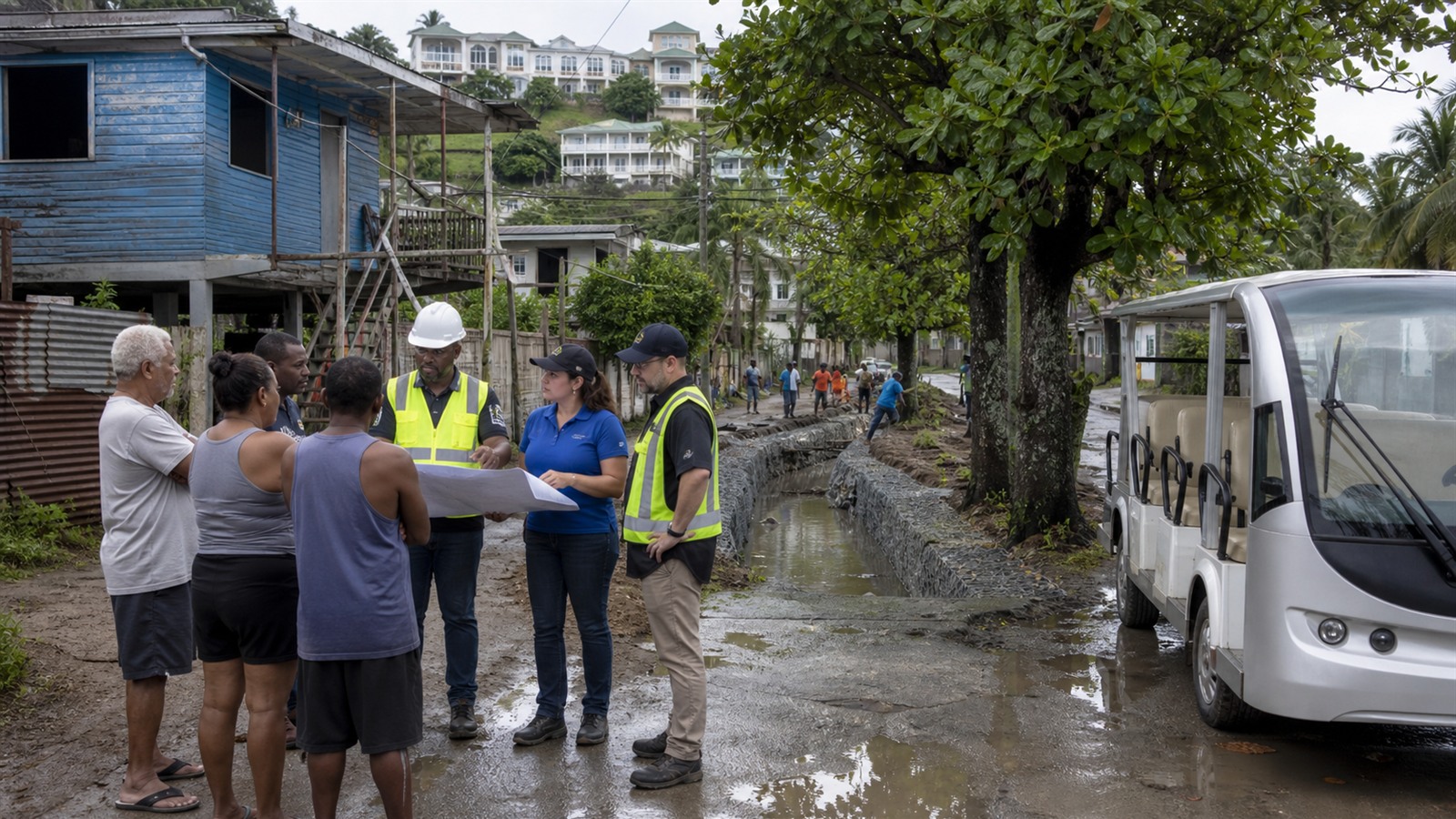
An equal program begins with a public vulnerability map built from heat, flood, fire, health, housing, disability, work, income, and infrastructure data. Models should be open to review and corrected by residents who know blocked drains, unsafe buildings, language barriers, or informal care networks absent from official records. Data guides priority without reducing a community to a risk score.
Funding then follows need rather than local matching ability. Poor jurisdictions should not receive less because their tax base cannot contribute to a grant. National or regional pools can finance full project costs, technical assistance, and long-term operations. Wealth and high-emission activity can carry greater fiscal responsibility through progressive taxes and charges.
Housing measures must protect tenure. Cooling, insulation, drainage, and elevation can raise property values and rents, displacing the residents whose vulnerability justified the project. Rent stabilization, right to return, property-tax relief for low-income owners, community land trusts, and social housing keep benefits attached to people and place.
Employment standards make adaptation an economic development program. Local residents need accessible apprenticeships and actual hiring pathways, while sector agreements protect wages, safety, and portability. Community preference should not become exclusion of migrant workers or a pretext for weak standards. Public employers and contractors can build a durable maintenance workforce.
Universal design reaches people often left out of emergencies. Cooling centers, warnings, shelters, transport, and applications must support disabilities, varied languages, children, older adults, and people without digital access or formal documents. Trusted community institutions should receive stable roles and finance rather than temporary volunteer expectations.
Governance continues through implementation. Resident boards can review budgets, timelines, complaints, and displacement data. Independent inspectors protect safety and rights. Regional institutions resolve spillovers across watersheds and grids. No one forum represents every interest, so multiple routes for participation and appeal reduce capture.
Finally, adaptation cannot become permanent acceptance of rising danger. Projects should connect to binding mitigation and managed retreat where protection cannot remain safe. Equality means honest information and real relocation choices, not expensive defenses for wealthy property and repeated disaster for everyone else. An eco-socialist program joins immediate protection to structural emissions reduction. Consumption inequality requires careful policy. Luxury aviation, oversized homes, multiple vehicles, and frequent replacement carry different social value from heating, refrigeration, basic mobility, or development needs. Progressive standards and taxes can constrain excessive use while universal systems make low-carbon living convenient. The purpose is not moral surveillance of every purchase, but a material hierarchy that protects sufficiency before status consumption. Adaptation also creates financial assets. Land behind a new barrier may appreciate, and private firms may gain contracts, data, or patents from publicly funded resilience. Public equity, land-value capture, open technology, and community ownership return some gains to the people financing and hosting projects. Otherwise redistribution at the spending stage can become concentration at the ownership stage. Climate inequality must be evaluated over time. A rebate may lower this year’s bill while a private utility builds costs into future rates. A training program may enroll workers without placing them in durable jobs. A relocated family may receive compensation but lose networks and rising land value. Longitudinal data and organized community monitoring reveal these delayed transfers. Eco-socialism’s distinctive contribution is to treat inequality as power capable of reproducing itself. Income support matters, yet owners can still shape investment, employers can impose exposure, and wealthy jurisdictions can capture protection. Social ownership, bargaining, fiscal equalization, and rights change those governing relationships. The aim is not merely to help people endure an unequal climate economy, but to prevent unequal power from designing the transition. Intergenerational inequality complicates present distribution. Young and future people inherit greater physical risk, yet current workers and communities depend on existing systems. A fair plan accelerates retirement of harmful assets while preventing abrupt livelihood loss. Long-term public finance can spread construction costs across beneficiaries, but it should not leave future residents paying for assets already obsolete. Durability and adaptability are fiscal justice. Information about risk must not become another inequality engine. Detailed flood or heat maps can guide protection but may immediately lower property values or trigger insurance withdrawal before public alternatives exist. Authorities should pair disclosure with finance, purchase options, tenant protection, and phased plans. Honest warning is essential; abandoning people after warning is not. Rural inequality deserves distinct tools. Sparse settlement raises costs for transit, healthcare, grids, and emergency response, while farming, forestry, and extraction connect livelihoods to land. Cooperative services, distributed energy, regional public transport, broadband, mobile care, and stewardship employment can expand low-carbon access without copying urban forms. Decision rights should reflect local knowledge while meeting wider ecological standards. Urban inequality likewise extends beyond neighborhood projects. Metropolitan housing and labor markets cross municipal borders, allowing affluent suburbs to exclude homes while central cities carry services. Regional finance, fair-share housing, integrated transit, and watershed governance distribute duties across the actual system. Local democracy cannot justify exporting costs to residents with less voice. Eco-socialist equality is relational: one group’s security should not depend on another’s exposure, invisible labor, debt, or displacement. Tracking transfers across place and time reveals whether a program genuinely shares climate safety or merely moves the frontier of harm. Procedural equality requires reasons people can use. An agency should explain why one block, workplace, or region receives priority, disclose uncertainty, and show how residents can challenge errors. Appeals need deadlines because delayed protection during heat or flood can be meaningless. Independent review should examine patterns, not merely individual files, so repeated exclusions lead to system redesign. Distribution within households also matters. A subsidy paid to an owner may not reach the tenant; income controlled by one partner may not secure another person’s safety; household averages can hide unequal care, food, or cooling. Direct benefits, individual rights, and service access prevent family structure from becoming an invisible gatekeeper. Equal transition policy should widen future choice. Training must lead to portable credentials, accessible jobs, and career progression. Relocation support should preserve the ability to rent or own elsewhere. Community assets should generate continuing revenue, not one-time payments. The goal is capacity that remains after a grant or project ends. These details turn solidarity from a slogan into an institutional property: people facing different dangers can rely on common systems without losing recognition of their distinct needs and authority.
Equality Improves Climate Effectiveness
People support change when alternatives work and burdens are credible. Universal services, good jobs, lower bills, and public ownership create constituencies for durable action. Policies that deepen insecurity invite backlash and delay.
Eco-socialism addresses climate inequality by moving beyond compensation after harm. It changes investment priorities, ownership, workplace power, and access to essentials so those most exposed can govern the transition. The standard is shared security within ecological limits, not equal exposure to sacrifice.